
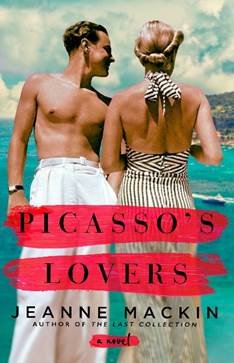
Happy Friday! I have a wonderful new historical fiction novel to share with you this week – I’m stepping out of my Regency and eighteenth-century world into the twentieth century thanks to Berkley gifting me a copy of Jeanne Mackin’s new novel Picasso’s Lovers. If you love art, political and gender history, this one is for you…
In Picasso’s footsteps
In New York City in 1953, Alana Olson has lost her mother, Marti, and is struggling to make it as a journalist. Not only that, but her involvement in a student protest seems to have McCarthy’s anticommunist spies on her tail. Her fiancé, William, has little regard for Alana’s ambitions to write about art, instead pushing her to set a date and settle down.
But Alana knows she can do it: so she sets out to write an article about Picasso, her mother’s favourite, and sets off in pursuit of Sara Murphy outside of the city, a friend of the great artist to discover more about his life… and the women in it.
When Alana meets Sara, she finds a woman unsure about opening up, but when she does, she can’t stop. Sara recounts the fraught, creative and hot summer of 1923, which she and her husband Gerald spent in Antibes with Picasso, his wife Olga, and an enigmatic young maid named Anna, who seemed to be running from something.
Giving women a voice
What follows is an unravelling and piecing together, in fictional form, of the women of Picasso’s life.
You don’t have to know much about art, or indeed Pablo Picasso, to know he was famously awful to the women in his life. Many of them were artists themselves, but were widely seen as only muses to his own creative expression, and Jeanne Mackin’s novel seeks to undo this. From Irène Lagut, to Olga Khokhlova, to Françoise Gilot, Jacqueline Roque, and indeed, Sara Murphy, each woman is a complex character who unfolds around and outside the legend of Picasso.
I really enjoyed the voices she gave to each female character: without making each woman purely placidly likeable, she evokes sympathy and strength in each of their dealings with the artist. Though Alana is in search of him, on his trail as the story alternates between the 1920s and 1950s, it is not really him that is important, but the relationships of the women around him.
I liked Alana’s character too. She is not only a vessel to capturing the Picasso of the 1920s, but a fascinating character who I think resonates beyond the 1950s: her worries about balancing a career and a family are timeless and well-written in her pockets of the story.
Not only this, but she made me approach Picasso’s art in a different way, and think about some of his most well-known pieces, from Guernica (1937) to The Lovers (1923) afresh. Although fictional, it is always lovely to connect with a subject matter and find new interest, or new perspectives.
I’d never read any Jeanne Mackin before, but I enjoyed this book so much, I will definitely be reaching for some of her other novels in future!
Thank you to Berkley for gifting me a copy of Picasso’s Lovers in exchange for honest review.
 Dr. Lizzie Rogers
Leave a comment